
The challenges the world faces: how repair and reconciliation fit into that picture.
Speech made by Tad Kelly at the Reichstag in Berlin on 25th June 2026 at an event to commemorate the 5th anniversary of the reform to the German Constitution
Good afternoon. My name is Tad Kelly and I live in Denver, Colorado in the United States. It is an honor to be back here among you today, on this, the fifth anniversary of the passing of the amendment to Article 116 of the German Basic Law. Let me start with a sincere thank you to all our hosts and speakers from the German government. The symbolism of your presence here today cannot be overstated. And, neither can our gratitude to you for your generous support.

Tad Kelly presenting this speech at the Reichstag, Berlin
Ursula’s story : one family among many
My connection to this groundbreaking accomplishment began in 2019 as I was researching my mother-in-law Ursula’s experience of escaping in September of 1939 from Danzig, and then Poland, to Italy and Portugal and finally to Brazil. She and her parents arrived in Rio de Janeiro in early 1940, where they knew no one. Ursula was seven years old, and her parents’ possessions amounted to little more than the clothes on their backs. Initially, they survived because Ursula’s mother went door to door in the nicer areas of the city, offering to sew handmade dresses. About a dozen years later, Ursula met an American Naval pilot, Edward Anderson, at an American Independence Day celebration. They were married a few years later, and he brought Ursula and her parents to the United States. Luckily for me, Edward and Ursula had three children, the youngest of whom, Wendy, I was fortunate enough to marry 37 years ago.
While researching Ursula’s story, I came across an article about a newly formed organization called the Article 116 Exclusions Group. Its goal, I learned, was to amend a section of the German Constitution pertaining to citizenship. Let me say that in a different way – They… Want… To… Change… the… German… Constitution… Ja, viel Glück damit! Good luck with that! Nevertheless, I reached out to Felix and Isabelle and discovered that this group had been formed and led almost entirely by these two ordinary people without connections or financial resources. I remember thinking to myself, “These two are very nice, but they have absolutely no chance”.
And yet, here we are, five years later – to the day – after this monumental feat was accomplished. As a result of the amendment to Article 116, Ursula—just three weeks before she passed away—received her German citizenship. My wife received hers, and all three of our daughters received theirs. And our family is just one among so many. In fact, since the amendment came into force, tens of thousands of people around the world have had their German citizenship restored, including some 12,000 in this past year alone. So… never underestimate what two NOT ordinary people can do, supported by a righteous cause and a determined group of allies within and outside the German government
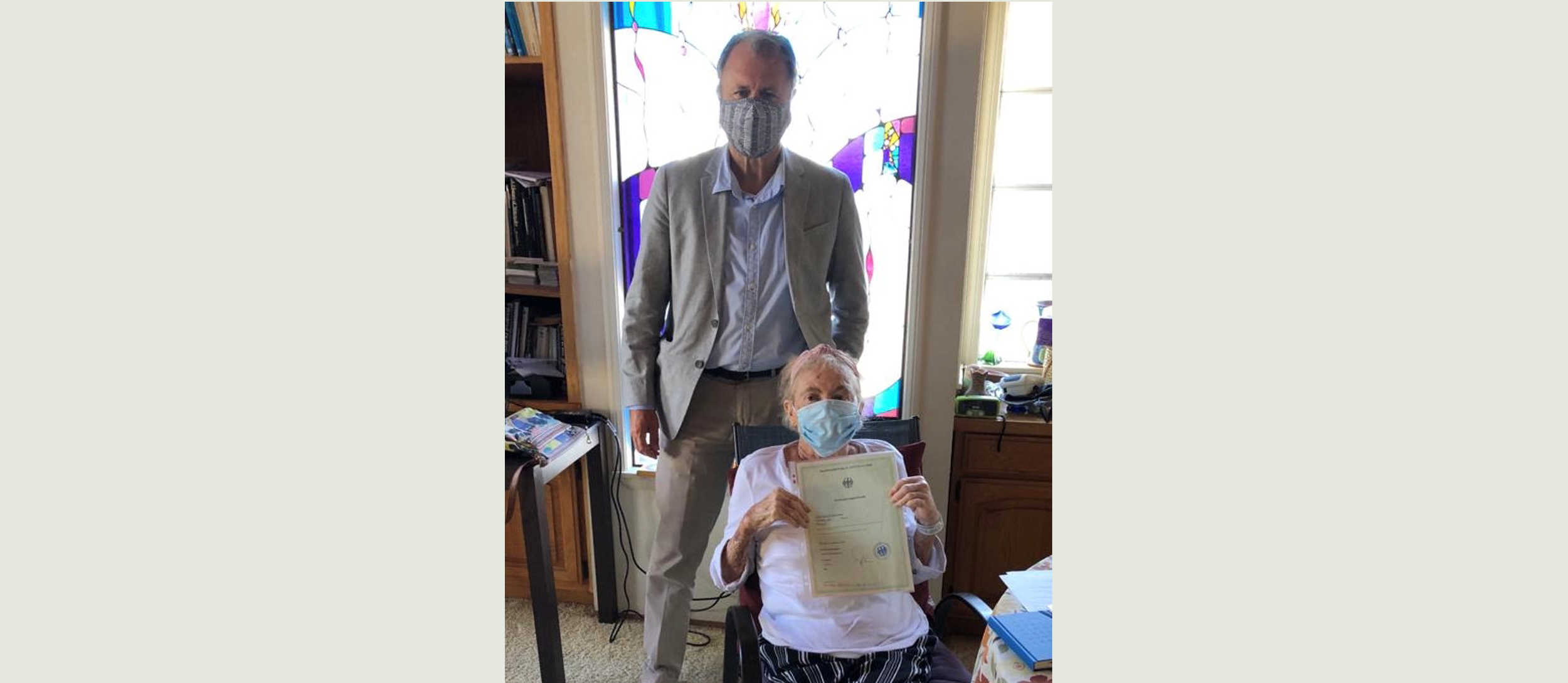
Ursula Anderson Kantor receiving her German citizenship at her home from the Honorary German Consul in San Diego, just two weeks before she passed away.
Reconciliation and the pillars of democracy
Today is about marking an anniversary and it is about reconciliation, and I would like to share some thoughts with you, from the perspective of an ordinary American, about the challenges that the world faces and how repair and reconciliation fit into that picture.
What I worry about most right now is the rising tide of anti-democratic sentiment around the world, particularly within democratic countries. Most people agree that the central pillars of a healthy democratic society are these: first, strict adherence to the rule of law; second, free, fair and trusted elections followed by peaceful transfers of power; third, an independent legislature, judiciary and press; and fourth, a civil society that centers, among other values, the protection of free speech and minority rights. When these all come under coordinated and continuous assault, it is cause for great concern.
It may be useful to remind ourselves that, historically speaking, democracy is a relatively new idea, and it has proven to be a risky experiment in self-governance. But, as Winston Churchill famously said, “Democracy is the worst form of government except for all the others that have been tried from time to time.”
From a reconciliation perspective, the essential pillar of democracy that I would like to focus on today is the fourth one: a civil society that centers, among other values, the protection of free speech and minority rights. This is because a tolerant society is a prerequisite to reconciliation. Indeed, it is the oxygen on which reconciliation depends. Reconciliation is not a political process – it is a deeply human one – but, the political atmosphere has a fundamental impact on how much of that oxygen is available for difficult conversations among people in society with different perspectives or experiences.
A well-functioning civil society depends not only on laws and institutions, but also on the habits and character of its citizens. Political philosophers from Aristotle to Alexis de Tocqueville have pointed out that free societies require certain individual civic virtues if they are to endure. Let me name a few:
• Honesty — You tell the truth and you keep your word.
• Responsibility — You own your actions and you fulfill your obligations.
• Respect — You honor the dignity and the rights of others.
• Tolerance — You accept pluralism and engage in peaceful disagreement.
• Courage — You defend democratic principles and institutions when they are threatened.
• Humility — You accept that you are not always right and you remain open to learning from differing perspectives.
Threats to Reconciliation
We know that all societies have a minority of people who refuse to play by the rules, and people who seek to sow suspicion and distrust among their fellow citizens. Historically, these people were largely dismissed or shunned, because their behavior was deemed unacceptable. Societal norms provided behavioral guardrails. But when we elect leaders who not only fail to practice these civic virtues, but who actively reject them – and even attack those who seek to uphold them – it gives permission to other political leaders, at home and abroad, as well as to members of the general public everywhere, to do the same.
When modes of personal conduct that in the past were considered almost unthinkable become normalized by our elected leaders, we risk the breakdown of societal norms. When, as individuals, we are no longer willing to make the effort to hear someone out or to show them common courtesy, we have lost our way. And when a society loses its willingness to care for its most vulnerable and disadvantaged members, it risks losing its very soul.
We do not have to imagine where this road can lead. Ursula’s family, like so many others, experienced it firsthand. In Danzig, after 1933, the unimaginable became ordinary - one small step at a time – a single party takes over city hall, a business is boycotted, a neighbor stops greeting you on the street – until, in July 1939, a family that has been an active part of that city’s social and political life for more than two decades has to abandon everything and flee. As the historian Milton Mayer wrote in his book on pre-war Germany (and I quote), “Each step was so small, so inconsequential, so well explained that, unless one understood what the whole thing was in principle, what all these ‘little measures’ must someday lead to, one no more saw it developing from day to day than a farmer in his field sees the corn growing. One day it is over his head.”
Every one of these behavioral aberrations presents a challenge for societal reconciliation because, the truth is, reconciliation is a fragile process. As I said three years ago here in Berlin, “reconciliation is a joint and voluntary process which must have the authentic engagement of members from all the affected parties. It also requires open mindedness, open heartedness, sincerity, goodwill and perhaps most of all, courage.”
Let me add honesty, mutual respect, individual responsibility and tolerance. These all seem to be in short supply today. And when our leaders show us by their actions that we don’t need to care about those around us, it emboldens the rest of us to belittle and disparage anyone we choose. When that happens, we forget our sense of common humanity. This is the biggest threat today to reconciliation movements all over the world.
“When our leaders show us by their actions that we don’t need to care about those around us, it emboldens the rest of us to belittle and disparage anyone we choose. When that happens, we forget our sense of common humanity. This is the biggest threat today to reconciliation movements all over the world.”
Take the middle road, and keep swimming
Because of the African-American and Native-American repair and reconciliation work that I am involved with, I am frequently asked how it is possible to move forward with this important work in the face of active opposition from the very highest levels of government and within the general population.
So, this is how I think about the current political environment. There are times in history when those of us who believe in civil society find ourselves swimming downstream, and other times when we find ourselves swimming upstream – against the current. There is no doubt that right now in many democratic countries, we are swimming upstream. I find that most people react to this countercurrent in one of two ways: first, those who stop doing the repair and reconciliation work because they are frightened or overwhelmed, or second, those who want to double down, to work twice as hard to achieve their honorable objectives. I encourage people to take a middle road because, as we know, the path to reconciliation is a long and winding one. On the one hand, we cannot – we can never – afford to stop this important work. On the other hand, if we redouble our efforts against a strong current, it will quickly exhaust us, we won’t be able to carry on, and we might even be swept downstream. So, I tell people to just keep swimming. Don’t get discouraged, don’t panic. Just keep swimming at a steady pace. No more, no less. Continue to show up, continue to be counted. This period will pass. No state is permanent. In fact, sooner or later, we will find ourselves swimming downstream again. Let’s be ready for when that happens.
Reasons for optimism
And I like happy endings anyway. So, let me finish by saying that I am optimistic about the future. My optimism does not rest on predictions; it rests on evidence, and much of that evidence is in this room. Five years ago, right here, something happened that most had thought impossible: the German Constitution was changed – because two extraordinary people asked for justice, and a courageous government chose to listen.
And finally, on a personal note, six months ago, my wife, Wendy, and I became grandparents for the first time. And just last month, our granddaughter, Claire, was at the German consulate in Los Angeles with her parents, submitting the papers necessary to receive her German passport. Claire will grow up never knowing a time when her family was not welcome in Germany. That is entirely thanks to the work that all of you committed to long ago, and that came to fruition in this very building five years ago. It is proof that the work of reconciliation is not measured in election cycles but in generations. And it is proof that acts of repair can not only survive difficult periods but can endure in perpetuity. So, just keep swimming!
Thank you very much.